vada pav & dabeli variations
i live in the suburbs, and sometimes i wish i didn't. everything is so sprawled out and generally unwalkable. it's very difficult to survive without a car. however, since this pandemic has unfurled the spaciousness of my neighbourhood has made it ironically a more walkable place. it affords adequate physical distancing measures to be carried out while still being able to take daily walks outside and get some fresh air. also the suburbs where i live, because housing tends to be more affordable, attracts immigrants from all over the world (such as my parents). and if you want wonderfully unfamiliar flavours assembled by experienced culinary artists from parts of the world you didn't even know you were ignorant about, and at more affordable prices than the city, the suburbs are where it's at in my view. it's how you get your Jonathan Gold on. anyway, one evening this past week, i took a walk with my mom, and as we were passing a neighbourhood plaza, we decided to stop by a spot called Milan. they specialize in ice cream, chai, and Indian street food.
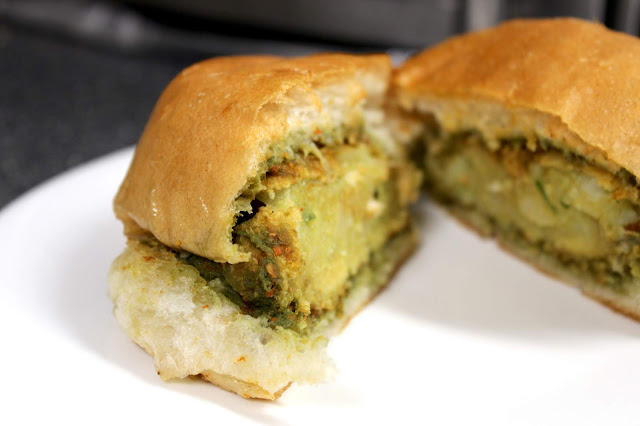
one of the sandwiches i've most recently tried is their rendition of 'dabeli'. its divine enough that if you listen carefully you can hear beethoven's diabelli variations wafting out of the chutney as the pomegranate seeds burst in your mouth.
 'dabeli' hails from the Kutch district of Gujarat. 'dabeli' means 'pressed' in the Gujarati language. the worker behind the counter described it as a sandwich with mashed potatoes garnished with peanuts and pomegranate. the potatoes are cooked with a special masala (from Kutch), and then topped in this case with tamarind and red date chutneys.

some 'sev' (that garnish of thin crunchy little noodles made of chickpea flour) is sprinkled on top before the top bun descends. my parents did grow up in Singapore. however, as might be obvious, i still don't know all that much about Indian cuisine, not to speak of special regional indian street food specialties. this was my first time trying dabeli, but i enjoyed it tremendously. a nice mixture of sweet and savoury. my favourite sandwich from Milan though is their 'vada pav': a seasoned potato fritter fried in a chickpea batter, smeared with mint, coriander, and garlic chutneys and a house-made garlic powder, cradled between two lightly grilled buns.

what i find interesting about these sorts of foods is they exhibit the dynamism of culinary milieus in India, but also offer themselves as portals into the complex political contexts out of which they emerged. 'vada pav' is a rather 'recent' vegetarian fast food innovation that was likely 'invented' in the 1960s and emerged in Mumbai in the 1970s. it is typically thought of as a Marathi food (which may be in part due to the unsavoury ethno-politics of Mumbai), and the sandwich's name comes from the Marathi term 'batata vada' (potato fritter) and 'pav' (bread bun). it's been an affordable and favourite food stall snack for decades among students and factory workers (especially in the textile industry), that even McDonald's has failed to fully co-opt successfully.
it has, however, been rather successfully weaponized by the right-wing anti-immigrant semi-fascist party Shiv Sena. the political party sponsors 'vada pav' festivals (“Vada Pav Sammelan”) and has been involved in attempts to consolidate a chain of 'vada pav' stalls, under the pretence of creating more jobs through training programs that require monopolized sourcing of raw materials for 'vada pav' to 'ensure' hygiene and quality control.
Duke University cultural anthropology and global health professor Harris Solomon, wrote an interesting article entitled "The Taste No Chef Can Give: Processing Streetfood in Mumbai", which draws on the work of Gregory Bateson to think through the dynamic assemblage of 'vada pav' physically as an object, but also historically and politically (as a process):

i've been there a couple times, to indulge in some chaat or catch up with a friend over the rich pink hues of kashmiri tea. it's often packed, even late into the night, but you can tell this pandemic has taken its toll on the place. yellow tape criss-crosses the unit, chairs stacked on tables. one or two people trickle in every few minutes to grab take-out. i mean i can frame my visit as an altruistic act to support a small local business, but in all honesty i just really like their food, and i hope i'm not being irresponsible by stopping to buy take-out. south asian street food is essential, right?
one of the sandwiches i've most recently tried is their rendition of 'dabeli'. its divine enough that if you listen carefully you can hear beethoven's diabelli variations wafting out of the chutney as the pomegranate seeds burst in your mouth.


some 'sev' (that garnish of thin crunchy little noodles made of chickpea flour) is sprinkled on top before the top bun descends. my parents did grow up in Singapore. however, as might be obvious, i still don't know all that much about Indian cuisine, not to speak of special regional indian street food specialties. this was my first time trying dabeli, but i enjoyed it tremendously. a nice mixture of sweet and savoury. my favourite sandwich from Milan though is their 'vada pav': a seasoned potato fritter fried in a chickpea batter, smeared with mint, coriander, and garlic chutneys and a house-made garlic powder, cradled between two lightly grilled buns.

what i find interesting about these sorts of foods is they exhibit the dynamism of culinary milieus in India, but also offer themselves as portals into the complex political contexts out of which they emerged. 'vada pav' is a rather 'recent' vegetarian fast food innovation that was likely 'invented' in the 1960s and emerged in Mumbai in the 1970s. it is typically thought of as a Marathi food (which may be in part due to the unsavoury ethno-politics of Mumbai), and the sandwich's name comes from the Marathi term 'batata vada' (potato fritter) and 'pav' (bread bun). it's been an affordable and favourite food stall snack for decades among students and factory workers (especially in the textile industry), that even McDonald's has failed to fully co-opt successfully.
it has, however, been rather successfully weaponized by the right-wing anti-immigrant semi-fascist party Shiv Sena. the political party sponsors 'vada pav' festivals (“Vada Pav Sammelan”) and has been involved in attempts to consolidate a chain of 'vada pav' stalls, under the pretence of creating more jobs through training programs that require monopolized sourcing of raw materials for 'vada pav' to 'ensure' hygiene and quality control.
Duke University cultural anthropology and global health professor Harris Solomon, wrote an interesting article entitled "The Taste No Chef Can Give: Processing Streetfood in Mumbai", which draws on the work of Gregory Bateson to think through the dynamic assemblage of 'vada pav' physically as an object, but also historically and politically (as a process):
"Vikram Doctor, one of India’s most influential food writers, traces the origins of the pav (the bun) to either the Portuguese who first settled the islands of Bombay, or perhaps later to Goan and Irani immigrants who opened Bombay’s first bakeries. Doctor explains that the vada (the potato ball) most likely comes from Maharashtra, and notes that potatoes themselves are of British origin dating back to the nineteenth century. Over time, potatoes spread to the city, and “sliced thin or mashed they were dipped in chickpea batter and deep fried as a snack” and then served in a bun."
though the British (or Portugese) brought the potato to India, it's worth noting that potatoes are from the Americas, brought to Europe by Spanish colonizers. Solomon goes onto take another writer's take on potatoes in India and Mumbai in particular:

this strike itself is very fascinating to me, and i have been browsing through a number of journal articles and a book on it trying to understand how leftist politics factored and failed to factor into such an impressively sustained strike, what were the reasons it ultimately failed, and how that left a power vacuum for Shiv Sena ascendancy.
the first account of the strike i think is worth mentioning is a paper by Bharat Patankar. his wife Gail Omvedt refers to him as a "nontraditional Marxist" in her book "Reinventing Revolution: New Social Movements and the Socialist Tradition in India". Patankar is one of the founders and leaders of the Shramik Mukti Dal party (translation "toilers’ liberation league") in the Maharashtra state (where 'vada pav' hail from). They are Marxists of sorts that also draw on the intellectual and political legacy of Jyotirao Phule and B.R. Ambedkar, anti-caste activists and Dalit revolutionaries integral to modern India. Phule is often credited with coining the term 'dalit' which can mean 'oppressed' or 'ground down', reminding me of the sandwich name 'dabeli' which means 'pressed'. Ambedkar was a fascinating figure who became a heterodox Buddhist at the end of his life, writing fascinating stuff on both Marx and the Buddha that i hope to look into some day. anyway, Patankar's account of the strike ("The Bombay Textile Workers' Strike of 1982: The Lessons of History") is an interesting glimpse into how certain leftists understood the strike's successes and failures in Indian political history:

as I was heading towards the exit of Milan back to the quiet suburban streets of my neighbourhood, the store owner assured me that if i didn't like the 'vada pav' i could come back and get a full refund. he had just thrown in this wonderful sweet sauce as he packed my meal to go. i can understand why political propagandists thought 'vada pav' would be a useful culinary object to leverage. my favourite sort of junk food. yes to vada pav, no to chauvinistic fascist politics.
"A city-beat journalist, Dhruv, anchored the origin point of the vada pav in earlier events that linked potatoes to Partition. During Partition, he explained, large numbers of Hindus from Sindh Province in Pakistan were relocated to a temporary settlement a few hours from Bombay. The settlement became Ulhasnagar, now also known as Sindhunagar, because so many Sindhis remained in the ensuing years. Sindhi rail commuters bound for the city often carried spiced potatoes and bread, staples back in Sindh. Vada pav was born out of the contradictory needs of these commuting refugees: the need for a mobile snack composed of a comforting, if crumbly, staple. Crumbling spiced potato balls would often fall from the bread. A clever vendor began to batter and fry the balls. With improved structural integrity, commuters could enjoy a mobile potato snack without worrying about a stained kurta. “You can still get a vada pav without the batter in Ulhasnagar, even today,” Dhruv told me. Once this battered potato ball sandwich took up residence in Mumbai, the city’s diverse residents changed it over and over again with different chutneys, spices, and chilies, especially with the Maharashtrian staples of garlic, peanut, and chili."this work by Harris Solomon actually comes out of the doctoral dissertation he wrote at Brown University (called "Life-Sized: Food and the Pathologies of Plenty in Mumbai"), which I believe formed the basis of his later book published by Duke University Press called "Metabolic Living"). in this book he draws a very interesting link between the convenient alignment of ideology between the right-wing Shiv Sena and 'Western' fast-food corporations:
"Using the concept of “gastropolitics,” I first describe how a local political party branded its own version of the food and then show how corporate franchises inspired by McDonald’s rendered the vada pav “safe” and “clean” through mechanized standardization. Rather than take the metabolism of fried food for granted, I de-emphasize its consumption and foreground the political circumstances that inform and animate it through observations and interviews at street-side vada pav stalls, at new corporations determined to standardize vada pav, and with nutritionists who condemn the vada pav..."Solomon also discusses this link between Shiv Sena in his Cultural Anthropology paper:
"I asked a Shiv Sena official, Sanjay, about the alliance with fast-food companies. He dismissed my question with a wave of the hand and a laugh: “The vada pav is not fast food! It’s got mirchi [green chili], haldi [turmeric], and kothimbir [coriander]—it’s healthy food!” My intention in asking the question was to learn more about corporatization, but like the vendors in the booths at the sammelan, Sanjay spelled out the ingredients for me. That which sustained the Marathi manoos, even when processed, could hardly be unhealthy. And indeed, the Shiv Sena did link up with fast-food companies—a linkage between Hindu nationalism and corporate consumerism that scholars have pointed out as characteristic of the party’s work."the emergence of 'vada pav' as a wildly popular and iconic culinary symbol of Mumbai street food was actually a product of Shiv Sena seizing on a politically convenient circumstance of thousands of textile workers losing jobs as mill owners withdrew capital in the face of a remarkably sustained labour strike. throughout the 1970s there were waves of labour strikes throughout Mumbai textile factories, which culminated in the 1982 Bombay Textile Strike. almost a quarter-million workers across 65 mills struck together in solidarity for over a year. mill owners soon began moving their operations to other cities and states. many left for Gujarat (the state where the Dabeli sandwich is from), and in the end the Mumbai workers received no concessions, the majority of mills in Mumbai closed, and 150,000 were left unemployed.

this strike itself is very fascinating to me, and i have been browsing through a number of journal articles and a book on it trying to understand how leftist politics factored and failed to factor into such an impressively sustained strike, what were the reasons it ultimately failed, and how that left a power vacuum for Shiv Sena ascendancy.
the first account of the strike i think is worth mentioning is a paper by Bharat Patankar. his wife Gail Omvedt refers to him as a "nontraditional Marxist" in her book "Reinventing Revolution: New Social Movements and the Socialist Tradition in India". Patankar is one of the founders and leaders of the Shramik Mukti Dal party (translation "toilers’ liberation league") in the Maharashtra state (where 'vada pav' hail from). They are Marxists of sorts that also draw on the intellectual and political legacy of Jyotirao Phule and B.R. Ambedkar, anti-caste activists and Dalit revolutionaries integral to modern India. Phule is often credited with coining the term 'dalit' which can mean 'oppressed' or 'ground down', reminding me of the sandwich name 'dabeli' which means 'pressed'. Ambedkar was a fascinating figure who became a heterodox Buddhist at the end of his life, writing fascinating stuff on both Marx and the Buddha that i hope to look into some day. anyway, Patankar's account of the strike ("The Bombay Textile Workers' Strike of 1982: The Lessons of History") is an interesting glimpse into how certain leftists understood the strike's successes and failures in Indian political history:
"The textile workers were overcoming a defeatist tendency within the working class movement: the tendency of withdrawing from conflicts with only small gains and with a false sense of victory based on these gains. The new tradition of relentless struggle that they have established means that whether there is partial victory or complete defeat in terms of gaining immediate demands, the working class must continue its battle, learning from experience and widening its efforts on that basis, going ahead in the face of attacks from capital and its state. If we examine the history of the textile strike, we see qualitative changes in the forms and content of struggle. The term "strike" historically has meant bandhs (shutdowns by the workers and their supporters, not by owners or employers), marches, picketings, etc., in the cities, and idleness for the majority of workers who have gone back to their villages. In a country like India... almost all sections of workers are still maintaining relations with the agrarian sector-active relationships with agricultural laborers and poor and middle peasants...Another great paper that I've found on the Bombay Textile Strike is by Salim Lakha. Here are some excerpts from his paper entitled "Organized Labor and Militant Unionism: The Bombay Textile Workers' Strike of 1982":
By creating a conscious struggle in the countryside, the textile strike in Bombay definitely meant a historic breakthrough in the Indian working-class movement. Even without glorifying this contribution, one can say that within the limitations of the "conscious" communist factor and of the working class itself, the qualitative change shown by village struggles leading to the formation of organizations of the rural poor in one of the talukas (subdistricts) has at least sown the seeds for this breakthrough. While being involved in the creation of these qualitative changes, the main actors-the mass of textile workers-went beyond the leadership in certain respects, though with the aid of some communists. Datta Samant, the existing unquestioned leader of the textile workers, never imagined such qualitative changes. No leadership of the working masses can exactly forecast the march of the movement, but a leadership with an understanding of scientific socialism, actually emerging from the working-class movement, could at least have a general perspective about the march of events. The aid given by the Lal Nishan Party (LNP), on a big scale, and the Shramik Mukti Dal, on a small scale, played an important role in the shaping of the struggle...
...the leadership which the workers brought into their struggle was definitely surpassed by them and was forced to change its views about how to wage effective struggle. When Datta Samant first came into the textile workers' movement, he was attacking the red flag and communists in general, ignoring the historic gains made by the working class under communist leadership in its formative period. The work- ers made him stop this attack through their mass mood and actions. The changing of the flag should be considered a part of this change.
...Datta Samant, who in the beginning had talked only of wage raises and money in the workers' pockets, gradually started stressing the badli workers' questions, cancellation of the BIR Act, and standardization of workload and working conditions, and finally said in this rally: "We cannot remain satisfied with a big wage raise because a wage raise can- not change the society and our oppressive conditions. It cannot change the relation between the government and workers and cannot stop the workers' exploitation. So workers must start thinking about political struggle on the basis of a definite strategy of social and economic changes."
...Those communists who are taking part in the movement should abandon their bookish attitude and hollow revolutionary slogans and learn from this experience. If a petty-bourgeois radical like Datta Samant could learn this much, then those who call themselves revolutionary communists should go much beyond him.
Throughout the period of the strike the textile workers were a shining example of nonsectarian practice, and this in an atmosphere of extreme sectarianism exhibited by almost all communist parties and groups. By allowing each and every group ready to help in furthering the struggle to participate in the movement, they denied the establishment of a monopoly over the workers and their movement by a single leadership. At the same time they resoundingly ousted those people who were telling them not to fight or to withdraw from their fight, and by doing this they defined what is "nonsectarian" for the working-class movement."
"A distinguishing feature of the Bombay textile workers was their migrant character and continuing ties with the villages. A majority of the work force retained its rural links as indicated by the fact that 80 percent of the 250,000 employees had returned to their villages by the fifth month of the strike. 6 On their return, they either began doing agricultural work or were employed under the government's employment-guarantee scheme. Their absorption into rural society was facilitated through kinship obligations requiring reciprocity under conditions of economic hardship. One management-initiated survey of selected villages revealed that some families acknowledged their responsibility to assist their kinsmen during an "industrial famine," just as the latter had extended their support at the time of an "agricultural famine."? Those workers remaining in Bombay survived by securing employment in less remunerative occupations such as construction work, casual work in small industries, taxi driving, food vending, and other low-income activities.'Economism' is the term Lenin used to criticize 'trade union consciousness' in contrast to 'revolutionary consciousness', where workers' struggles were reduced to narrow economic demands (like higher wages or better working conditions) rather than fostering class-consciousness for the purpose of revolution. This tension has persisted within leftist politics, from Lenin's exchanges with Rosa Luxemburg and her exchanges with other communists (Social Reform or Revolution), to Deng Xiaopeng's reforms which were unfolding in the background of the 1982 Bombay Textile Strike, all the way to leftist discussions unfolding today. ironically, it was the Lal Nishan Party (Leninist in orientation) that was one of the few communist parties to fully throw its support behind Samant's calls for a large-scale strike. ultimately however, the strike failed to achieve its goals. Judy Whitehead in her essay in the book "Blood and Fire: Toward a Global Anthropology of Labor" goes into some of the reasons why the strike did ultimately fail. She starts with how it first unfolded:
...The rise of Datta Samant in the Bombay textile industry is partly explained by certain historical developments." Over the years, the largely Marathi-speaking Maharashtrian workforce experienced a relative decline in their economic conditions that made them more responsive to the regional chauvinism of the right-wing party, Shiv Sena. Under its influence, the class-based ideology previously promoted by the communists was displaced. The workers, shorn of their class outlook, were now more amenable to apolitical unionism resting upon economic appeals. Datta Samant's approach to labor issues was strongly centered upon achieving economic gains for the workers. His rival unionist in Bombay, George Fernandes, accused him of raising 'economism to the level of a philosophy that few have been able to do in the country'."
"Datta Samant was initially reluctant to call an indefinite general strike in Mumbai’s entire textile industry, due to his (and other union leaders’) perception that the outsourcing of weaving to the small-scale power-loom sector weakened the textile workers’ bargaining position. However, he was compelled to do so by workers’ representatives, who staged a protracted sit-in at his home, prior to a major rally on January 17, 1982. This rally marked the official commencement of the general strike. The workers were adamant that they needed a union that was independent from all political parties. They believed that the connection between political parties and trade unions, so prevalent in India’s industrial landscape, meant that unions had a divided allegiance. Often party platforms and electoral tactics could override workers’ democratic interests. For instance, the Communist-affiliated unions believed that the textile workers’ position was weak and that their demands were hence impractical. In addition, they judged that supporting a major strike would make the Communist Party unpopular with a middle-class electorate. They also feared that independent trade unionism, exemplified in the leadership of Data Samant, represented reformism that would wean workers away from Communist ideology. For the most part, they advised the unions they controlled to refrain from the participating in the general strike. However, they were overruled by their membership, most of which voted with their feet and joined the new union. The new union was called the Mumbai Girni Kamgar Union (MGKU) to both connect it to and differentiate it from the GKU that had led workers’ strikes in the 1920s and 1930s. Once the strike started, the Communist Party extended support to striking workers through the TUJAC, the trades’ union council that was formed during the strike to coordinate efforts among all the non-Congress unions active in the textile industry. They provided little logistical or manpower support, but did organize food donations for the striking workers. Due to their lukewarm support for the general strike, their membership declined steeply during this period, from about twenty thousand to one thousand members. From the beginning of the strike, the mill owners ensured that they were in a strong position. By outsourcing their production to the power-loom sector, hiring new, non-union scabs on a temporary basis, and stockpiling finished goods, they were able to maintain operations throughout the strike. There appears to have been no decline in the supply of textiles in Bombay over the eighteen-month duration of the strike. In addition, since the central government had nationalized numerous textile mills in Ahmedabad and Kanpur, as well as Bombay, it worried that rising wages and bonuses in Bombay would spill over into wage demands in other state-owned enterprises. Hence, the Congress Party had an added reason to support the mill owners in Bombay. In addition, Indira Gandhi, then prime minister, personally wished to prevent Datta Samant from emerging as a national trade union leader. Not only would a victory for Samant undercut the role of Congress-led trade unions, it could also end the period of “responsible” trade unionism. Hence, the central government was keen on opposing Datta Samant from the beginning of the textile strike. With the central government on its side, the mill owners were able to wear down the striking workers over an eighteen-month period and conceded, finally, to none of their demands."after the strike's failure, the Shiv Sena party was able to capitalize on this to offer entrepreneurial opportunities to unemployed textile workers to start their own vada pav food stalls as a means of employment. vada pav therefore offered a way to bring unemployed factory workers into the fold of ethno-fascist politics. before going into this though, i think its worth examining some excerpts from a paper by Juned Shaikh called "Worker Politics, Trade Unions and the Shiv Sena's Rise in Central Bombay":
“The Shiv Sena was launched in Bombay in 1966 on the plank of preferential employment for Marathi-speaking job seekers. It insisted that 80 per cent of the private and public sector jobs be reserved for the Marathi-speaking people (Maharashtrains)… a few years after its launch, the party won the municipal and the state assembly elections in the working class neighbourhoods of central Bombay. In fact, in the municipal elections of 1968 and 1973 the party won most of its seats in the working class neighbourhoods of the city. Shiv Sena’s electoral gains in central Bombay were at the expense of the left parties and the Congress… The working class neighbourhoods of central Bombay housed mostly Marathi-speaking textile mill workers and their families. A significant section of these workers were supporters of the communist unions ever since they led a successful textile strike in 1928. Since then, the communist unions had played an important role in trade union politics in the textile mills and had occasionally led strikes demanding an increase in wages and bonus payments, the lessening of work hours, and the improvement of conditions at work. It must be noted that all workers in the textiles industries were not supporters of the leftist unions… Another important point to note is that not all residents of the neighbourhood were workers. For instance, there were local traders and moneylenders who extended credit at high interests to workers during times of distress. But more importantly from the point of view of this paper, the neighbourhoods also had residents best classified as plebeians, either self-employed, or on the fringes of employment in Bombay’s industrial and financial sectors. As we shall see later, the Shiv Sena drew its muscular and electoral strength from this class. Most members from this class had an ethnically similar profile to the unionised mill workers, i.e., Marathi-speaking males, often migrants, belonging to the non-brahmin castes. …the Shiv Sena was not merely a product of the alliance between the Congress ruled state and central governments and the capitalist class in Bombay. Neither, can its rise be explained away as the logical endpoint of the ethnic solidarity of the Marathi-speakers… the most important factor on the worker’s mind was employment and maintaining his/her standard of living… If the workers’ primary concern was economic well-being, why did a section of the workers abandon the leftist unions who had a history of fighting for their cause? Did they perceive the Shiv Sena to be a better guarantor of their economic interests? This paper argues that the Shiv Sena made an impression in the working class neighbourhoods because of declining job opportunities in the textile industry, the economic promise held by its politics of identity, and its ability to mobilize people in the neighbourhood and use them to break strikes called by the leftist unions… Shiv Sena’s growth could be explained by a simple formula: the growth of capitalism gives birth to ethnic organizations… competition between individuals for scarce resources drives them to organize around non-economic solidarities like caste, religion, or language to acquire a bigger share of the resources… the state of Maharashtra was carved out from the Bombay Presidency of the colonial era in 1960… The road to the reaction of the state based on a common language had given birth to a discourse of ‘Maharashtrian pride’ and ‘superiority of Marathi culture’… The Shive Sena channelled the growing sense of unease by giving its followers a public enemy they could blame. Thus, south Indians who were competing for jobs with Maharashtrians and the ‘godless communists’ became the Marathi-speaker’s foes. At a later date, Muslims were also targeted by the party. …When the Shiv Sena was launched, the communist unions were their most ardent rivals. The party would often use violence to break strikes called by communist unions… …the Shiv Sena’s publication Marmik (The Essence), a weekly magazine… was used effectively to ridicule the outfit’s political opponents and communist unions in Bombay were often the favoured enemies. The communists were branded anti-national and portrayed as stooges of the Soviet Union and Chinese governments… when [S.A.] Dange said that the trade union movement in India should emulate the non-violent Gandhi movement, a cartoon in Marik showed Dange in a loin cloth (like Gandhi) but with weapons (acid bulbs) in his hands… Though the Shiv Sena branded itself as the party of protest with the interests of Maharastrians at heart, Marmik never criticized the capitalists or the government for the policies that would have affected its supporters… Though most industrialists in Bombay were not Marathi speakers, Thackeray [Shiv Sena’s leader] never turned his ire against them. In fact he praised them as ‘anna dates’ (great givers) who provided jobs to the millions of Maharashtrians.”it's fascinating how the Shiv Sena capitalized on the popularity of 'vada pav' sandwiches to launch 'employment campaigns' to both secure a marketshare of the fast-food industry through its own chain of 'vada pav' stalls, bring unemployed workers into their brand of right-wing politics, and use 'vada pav' as an anchor point to promote Maharashtrian pride at the expense of other migrant workers from the south of India. for example, the BBC's article on vada pav includes this remark by Mumbai-based food writer Meher Mirza:
"The vada pav was subsequently co-opted by the Shiv Sena in order to offer a Maharashtrian alternative to the Udupi joints that were extremely popular at the time,” explained Mumbai-based food writer Meher Mirza, referring to the stalls set up by people from the South Indian temple town of Udupi in Karnataka. Shiv Sena’s campaign followed the rise in popularity of several south Indian dishes: the dosa (a crepe-like pancake made from fermented batter, traditionally stuffed with a spicy potato filling) and the idli (a savoury steamed cake made from black lentils and rice). The goal was to convince Mumbaikars to spurn ‘outside’ snacks and embrace their own cuisine, a strategy that worked very well in those turbulent economic times."with the Marmik journal in sight, it's interesting to consider some aspects of the Shiv Sena's genesis in an excerpt on the party by Dietmar Rothermund's book "India: The Rise of an Asian Giant":
"It was founded by Balasaheb Thakeray, a journalist and cartoonist, in 1966 and adopted the name Shiv Sena (Army of Shiva). This was a reference to the great Maratha king, Shivaji, but it could also be taken as referring to the Hindu god Shiva. Mumbai is the most cosmopolitan city of India, but it is troubled by a combination of ethnic and class conflicts. The city is the capital of Maharashtra, but the Marathi-speakers who live in that city are mostly workers whereas business and industry is controlled by Gujarati-speakers. Morever, many south Indians from Tamil Nadu and Kerala flocked into the city and competed for jobs with Marathi-speakers. This provided much scope for the xenophobic propaganda of the Shiv Sena... In 1995... it formed an alliance with the Bharatiya Janata Party and ruled the state until 1999."anyway these two sandwiches offered a fascinating glimpse for me into the regional politics of India. from Gujarat, where 'dabeli' hails from and where many factory owners in Mumbai also originated from, all the way to Maharashtra's textile workers and their affinity for 'vada pav', weaponized by the right-wing Shiv Sena after the impressively sustained strike of textile factory workers in Mumbai. the whole thing is extremely fascinating to me, and very revealing of how ignorant i am of this big wide world all the vast diversity that spans this planet. remarkable. so while the vada pav's association with semi-fascist politics is unsavoury to say the least, it remains itself a savoury delight for which i know i will be returning for more.

as I was heading towards the exit of Milan back to the quiet suburban streets of my neighbourhood, the store owner assured me that if i didn't like the 'vada pav' i could come back and get a full refund. he had just thrown in this wonderful sweet sauce as he packed my meal to go. i can understand why political propagandists thought 'vada pav' would be a useful culinary object to leverage. my favourite sort of junk food. yes to vada pav, no to chauvinistic fascist politics.


Comments
Post a Comment